Built by Movement,
Betting on AI.
I'm a Product Manager who has rebuilt her life more than once — across the Philippines, Australia, Japan, Singapore, and now Germany. Every move taught me the same lesson: the future belongs to whoever can turn ambiguity into a working system. I don't have it all figured out — I just don't stop building while I figure it out. That's why I build AI products, and why I'm not going anywhere else.

A Narrative of Movement
Every place I've lived has left a mark on how I build. Here's the map of how a breadwinner from Cebu ended up building AI products in Germany — and why I believe this is exactly where the world is headed.
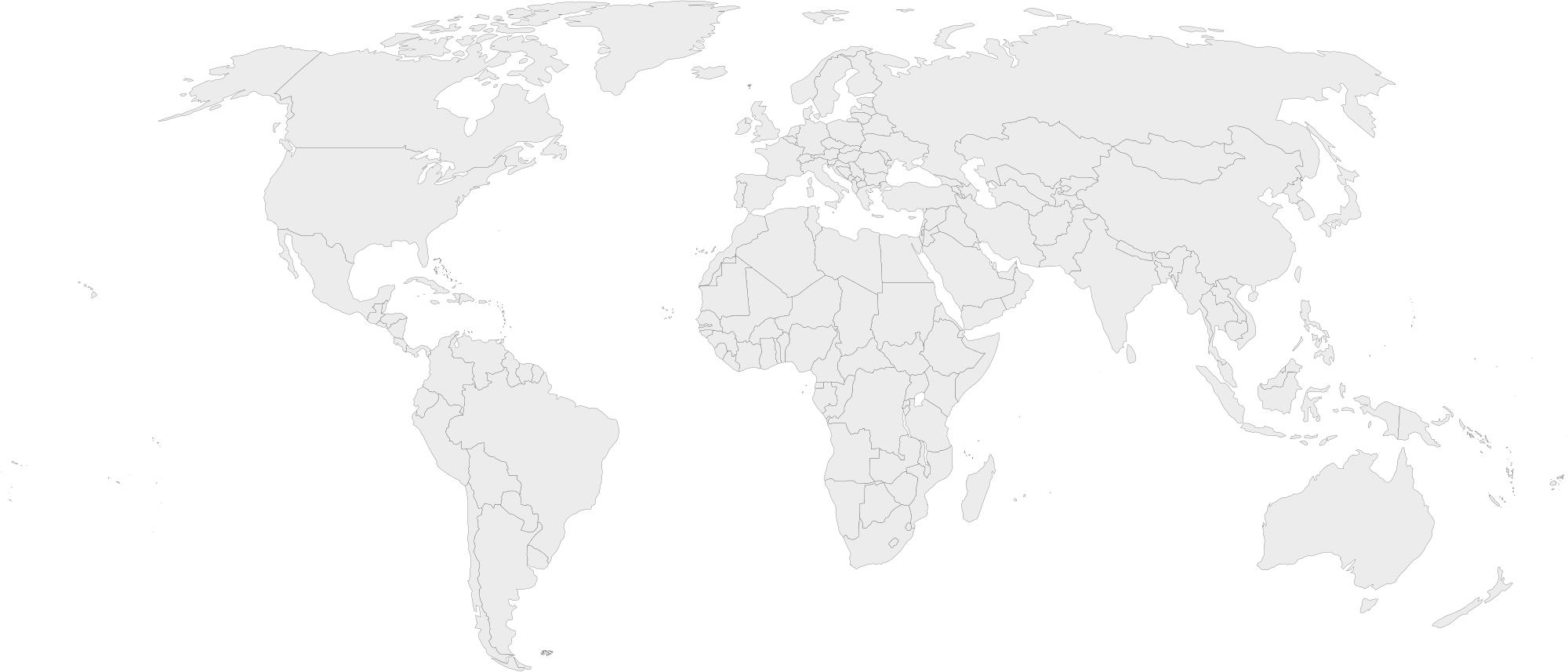
Where it started — I became my family's breadwinner young, rebuilding after we lost our home.
The leap — moved with 5,000 pesos and no safety net, right as the pandemic hit.
The scholarship — the only student sent from the Philippines that year.
Into tech — love brought me here, and it brought me into product.
Present day — building AI products, and a life with balance, from Germany.
Hover or tap any pin for the story behind it.
How I Work Under Pressure
How my working style tends to collide — and click — with other people's, specifically around conflict and crisis moments.
Moves fast, decides now
They want to call it done and move on. I want to make sure it's actually right first — that's usually where the tension starts.
When they call something "done" before I'm happy with the quality, that's usually where it starts. In a real crisis, they speed up and I get pickier, and the room can get tense fast. What actually works: give them a yes, plus one quick check — "we move, but let's validate this one thing first."
Needs the process to feel safe
We both care about getting it right, but they need the plan to hold still. Chaos is exactly what throws them off.
I pivot fast when things get messy, and they freeze or push back, which I can misread as them being difficult. What actually helps is naming the change out loud — "I know this shifted, here's the new shape of it." They just need the map before they can move again.
Here's what actually happens when things get tense: I move straight at the problem and want to own the fix — not just fast, but right. Chaos doesn't rattle me, it kind of wakes me up. And under real pressure, I get steadier, not louder.
Protects the mood over the facts
They'll smooth over a real problem just to keep the peace. I won't let it go until it's actually fixed.
They can read me as cold or harsh when I push on something they'd rather let slide, and I read their smoothing-over as avoiding it. What works better: lead with the relationship, then the issue — "I value what you built here, and I still need us to fix this part."
Needs the room before the decision
In a crisis, they want a meeting. I want a decision. Neither of us is wrong — we're just moving at different speeds.
If I move without them, they feel left out and quietly check out of the work. A five-minute heads-up before I act does more for them than it costs me — it reads as respect, not delay.
Still feeling it after I've moved on
I process something hard and move forward pretty quickly. For them, it can still be very much alive days later.
I can come across as dismissive without meaning to, just because I've already moved on and they haven't. What actually helps is closing the loop before moving forward — a simple "are we okay?" goes a long way.
The most common friction point for me isn't competence — it's pace and standard misalignment. I move with purpose, hold a high bar, and don't need much emotional runway. Most conflicts come from others needing more time, more consensus, or more reassurance than I naturally offer in crisis mode.
The leverage isn't changing my standard — it's briefly naming what I'm doing, so others can follow.
How I
Got Here
Not a list of job titles — the actual chain of decisions that got me from breadwinner to Product Manager.
Product Manager, AI Products
These days, I own the roadmap for the AI agents and automations we ship to clients through Solender AI's fractional Chief AI Officer offering. I won't pretend I arrived here with a five-year plan — I arrived here because every job before this one kept pointing me toward the same kind of problem, and this was the first place that let me work on it full-time.
Product Manager
Before that, I was running product across marketing, design, engineering, sales, and data science. I learned Python well enough to build my own internal tools — mostly because waiting for someone else's sprint cycle wasn't fast enough for what I needed. I'm still not the strongest engineer in any room I'm in, but I've learned enough to be dangerous, and dangerous enough to ship things that mattered.
Project Manager
Here, I rebuilt how the team actually worked — replacing scattered process with Notion and Slack, and cutting operational costs by 25% along the way. It sounds tidy in a sentence. In practice, it was a lot of unglamorous meetings and a lot of people trusting a process I was still figuring out as I went.
Chief Operating Officer
And before any of that, I was COO of a company mostly because someone needed to hold operations together while it scaled, and I said yes before I felt fully ready. I built out our systems — Jira, CRM, SPSS-backed research — the way you learn to swim: by being in the water. That's more or less how every chapter on this list started.
Why AI. Why Me.
Betting on AI
I didn't arrive at AI because it was trending — I arrived because it's the first tool I've used that matches the pace I've always had to move at. Every role I've held has been about turning a mess of manual, human-bottlenecked work into something that runs itself: a document generator instead of manual updates, a script instead of a dev-team backlog, an SOP instead of tribal knowledge.
AI is just the next, much bigger version of that same instinct. I believe the products that win over the next decade are the ones that use AI to remove friction, not bolt a chatbot onto an existing workflow — and that's the only kind of product I want to build. This isn't a detour in my career. It's the path I'm staying on.
What Makes Me Different
I've been the breadwinner, the COO, the trainer, and the product manager — often at the same time. Most PMs haven't run a company's day-to-day operations; most operators haven't shipped their own automation tools. I move between the human side of a problem and the technical side of the fix without needing a translator in between.
I've also rebuilt my life from scratch enough times — Philippines to Australia to Japan to Singapore to Germany — to know that resilience isn't a personality trait. It's a system you build under pressure. That's what I bring to every product I touch.
AI Agents & Automations I've Built
Proof that "Why AI" isn't just a belief I hold — it's a habit I practice. These are tools I've prototyped on my own time, built the same way I build at work: start with the annoying manual task, automate it, then see how far it can go.
Inbox Triage Agent
Reads incoming support and research emails, classifies intent, and routes each one to the right queue — with a drafted first response waiting for a human to approve.
Meeting-to-Roadmap Agent
Turns a raw meeting transcript into a structured product brief — decisions, open questions, and roadmap updates — formatted and ready to share.
Survey Insights Agent
Codes open-ended survey responses into themes automatically, so qualitative research doesn't get shelved just because nobody has time to read 800 free-text answers.
Client Doc Sync Agent
Watches a single source-of-truth document and automatically keeps every downstream client-facing file in sync — the AI-agent cousin of the tool I hand-built at HR.com.
Content QA Agent
Checks drafts against a team's style and brand guidelines before they reach an editor, catching the fixable stuff so human reviewers can focus on judgment calls.
Standup Digest Agent
Pulls updates from Slack and Asana overnight and delivers one clean digest each morning — the status update nobody has time to write, written automatically.
A Few Stories
I'm Proud Of
Not highlight-reel stats — just two moments where I saw a mess nobody was fixing, and fixed it.
TWO I'D TELL YOU OVER COFFEE
Scaling Performance and Efficiency
Problem: Rapid pandemic-era growth at Authority Titans outpaced alignment — writers, sales, and customer success were all moving fast without a shared standard, leading to rushed, inconsistent output.
Action: I built content guidelines with our top writers, promoted them into editor roles, and turned the whole process into one SOP the company signed off on.
Result: Shared accountability across teams, and a visible lift in output quality.
The Key-Document Fix
Problem: At HR.com, our internal "date builder" and our client-facing key documents lived separately — every change meant updating both by hand, with real risk of the two drifting out of sync.
Action: Rather than wait on a dev team with limited bandwidth, I built an automated key-document generator in Python myself.
Result: Manual rework disappeared, and client-facing materials stayed accurate by default.
"Automation isn't about replacing the human touch; it's about removing the friction that prevents us from being human."— SHAN LLAMIDO